01 / DYSTOPIAN NOVEL
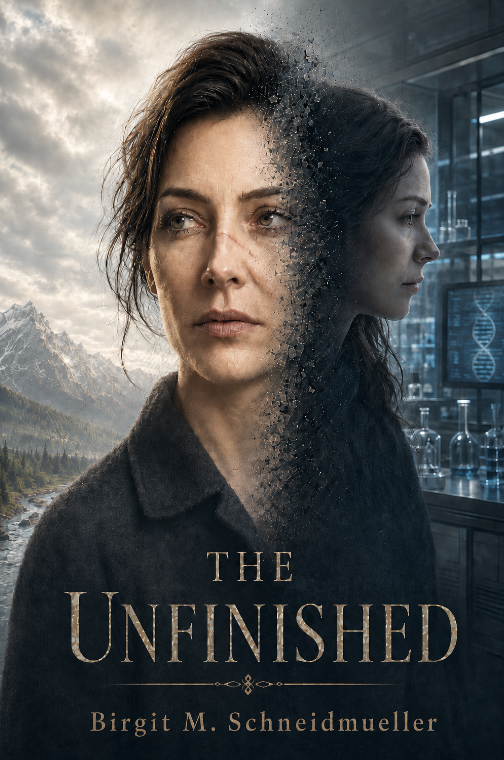
THE UNFINISHED
2045. A BLUE LETTER ARRIVES.
AFTER THAT, NOTHING ABOUT THE FUTURE
IS PERSONAL ANYMORE.
■ MANUSCRIPT IN PROGRESS
02 / THE PREMISE
WHO GETS
TO HAVE
A FUTURE?
In 2045, overpopulation has transformed reproduction, memory, and even mortality into matters of public policy. The government decides who may have children, whose lives merit preservation, and which losses must remain permanent.
When Hannah Eagle receives a Blue Letter, she becomes entangled in a project that promises to reconstruct and continue a human life.
If a life can be reconstructed and continued, who decides who gets to live?
03 / SUBJECT FILE
HANNAH
EAGLE
Hannah has lived within the rules for so long that she has almost stopped seeing them. The Blue Letter changes that.
It forces her to confront not only what the system has taken, but what she may be willing to take from someone else.
04 / BENEATH THE STORY
05 / READ
FROM THE MANUSCRIPT
CHAPTER
ONE
THE BLUE LETTER
Sometimes the remembrance of things past is the least desired state.
The scar across my nose sometimes itched, reminding me that my face told a story people wanted to hear.
My unruly hair drew attention easily, but the scar held it: a jagged line crossing my nose and disappearing into my cheek. Beauty comes from within, people said. Don’t judge a book by its cover. People said many things they did not practice.
I rarely explained how I got the scar. My colleagues did not know, and neither did my students. They knew there had been some sort of accident, because people always knew the outline of a tragedy even when no one had given them the details. They did not know about the weeks I could not remember or the years of my life that had become unreliable islands, appearing and disappearing without warning.
Sometimes, while teaching, I would look at twenty attentive faces and hear their voices dissolve into distant noise as fragments of the accident surfaced. A flash of light. A sound I could never quite place. The sensation of falling. Then nothing.
At other times, I could almost convince myself it had happened to someone else or not at all.
The scar made strangers curious and students cautious. It made some people pity me before they knew anything about me. They would have been wrong.
I was visibly scarred, not emotionally broken. At least, that was what I told myself every morning before walking to the mailbox.
Some days I checked before breakfast, still wearing pajamas and the old green cardigan I refused to replace. Other days I waited until evening, pretending that delay somehow counted as control.
The timing changed nothing.
The dread remained, followed by the same sharp relief whenever the mailbox did not contain a blue envelope.
The Blue Letter.
No one knew exactly how many had been delivered in Boulder. People had stopped discussing them openly months ago. Asking questions attracted attention, and attention had become a dangerous commodity.
People disappeared after enforcement. That much everyone knew. Some were said to have been relocated to agricultural districts or labor settlements. Others were rumored to have been detained indefinitely. A few mild offenders returned months later, thinner and unwilling to speak about where they had been.
Most did not return at all.
The government called the process resource reassignment.
Ordinary people called it removal when they were certain no one was listening.
As a college instructor, I felt particularly vulnerable. Schools had become nests of accidental disobedience: unauthorized room changes, unapproved materials, wasted electricity, political discussions disguised as literary analysis. Every practical decision carried the possibility of a violation.
I liked to think I could handle whatever life dealt me, although the scar suggested that life had never been especially interested in what I could handle.
After my morning coffee, I stepped outside and followed the narrow driveway toward the street. The air was crisp enough to make me regret leaving the house without a coat. Wind chased leaves across the pavement in skittering circles, and sometime during the night, autumn had claimed Boulder. The trees around my cottage had arranged themselves in red, orange, and stubborn patches of green.
For a few seconds, I allowed myself to admire them.
I had lived in the cottage for only three years, but it felt more like home than anywhere else ever had. It was tiny by the standards of the old world and extravagant by the standards of this one: one bedroom, a narrow kitchen, and enough land for two trees and a vegetable patch.
More space than one person was supposed to need.
I was allowed to keep it because the house had belonged to my parents and my father had been an honored military pilot. Families of certain deceased service members still qualified for legacy housing exemptions, although the government reviewed them more aggressively every year.
George, across the street, considered mine a personal insult.
He had never said so directly. George preferred concern to accusation. Concern allowed him to ask why one woman needed an entire cottage, whether I intended to take in a government-assigned tenant, and how often my grandmother had stayed with me before she died.
Since the government enacted the population codes, ordinary life had acquired a low, persistent hum of danger. A person could lose a home, a job, or freedom itself because a neighbor counted too many showers or noticed an unregistered overnight guest.
I shivered and blamed the cold.
Wednesdays had never suited me. They were indifferent days, stranded between beginning and end. That Wednesday apparently had ambitions.
My hand trembled as I reached for the mailbox.
The information skin on my wrist vibrated. The translucent biometric layer had replaced most of what people once carried in pockets: phone, identification, bank card, transit pass, medical record. It was convenient, nearly impossible to lose, and permanently connected to the systems that increasingly preferred citizens to be equally difficult to lose.
I pulled my hand back.
A university compliance notice glowed across the inside of my wrist.
RESPONSE REQUIRED.
For a moment, I stared at the words without understanding them.
Then I did.
Three days earlier, Professor Lin had asked whether his music students could use the auditorium during my assigned period. Their scheduled auditorium session was later that afternoon, but he had a medical appointment he could not postpone. He needed the acoustic system for a performance assessment and wanted to conduct it before he left campus.
My theater students could remain in our ordinary classroom. His students could use the auditorium while he was still there. No additional room would be occupied. No extra electricity would be consumed.
It had seemed like the kind of solution reasonable adults arrived at without involving the federal government.
I had agreed because it was sensible.
Sensible had become a dangerous defense.
The problem with systems built around prevention was that they eventually treated ordinary judgment as a form of risk. I had not stolen a room or hidden a tenant. I had let one professor use one auditorium at a different hour. Yet the notice on my wrist carried the weight of something much larger, as if practicality itself had become suspicious. That was the part I still had trouble accepting: the distance between what I had done and what the government was now entitled to do to me.
I opened the notice.
UNAUTHORIZED INSTITUTIONAL SPACE EXCHANGE.
The report included two photographs. In the first, my students sat in their classroom instead of walking toward the auditorium. In the second, Professor Lin stood beside the auditorium piano.
Both images carried verified timestamps. The reporting party was identified only as an institutional employee. I did not need the name. Ryan Splinter had watched my students remain in the room and asked, with false innocence, whether the schedule had changed.
Apparently, curiosity paid better than collegiality.
The notice instructed me to access the federal compliance portal within thirty minutes.
I looked toward the cottage, then at the mailbox. I still had not opened it. The blue envelope might already be inside, resting between an advertisement and the utility statement, waiting with the patience of government paperwork.
Something had already entered my life whether the letter had or not.
I went back inside the cottage and locked the door behind me. My coffee had gone cold. I drank it anyway while the government portal scanned my face, pulse, and residence code.
A rotating seal appeared.
POPULATION CONTROL.
The words produced the same sensation as hearing footsteps behind me in an empty street. Nothing had happened yet, but my body had already recognized the danger. That was what the Agency did best. It arrived first as a name on a screen, then a notice, a classification, something bureaucratic enough to seem harmless. By the time it became a person at the door, most of the decisions had already been made.
My case file opened.
VIOLATION Unauthorized Institutional Space Exchange
RISK CLASSIFICATION Escalated
STATUS Enforcement order active
DELIVERY METHOD Blue Letter
I read the status twice.
The order was already active.
The envelope was merely ceremonial.
Below the status appeared a narrow button marked APPEAL.
I pressed it.
OF ENFORCEMENT NOTICE.
I tried again, certain I had missed something.
The same message appeared.
A second link explained the procedure in language polished smooth by committees. Once the Blue Letter was delivered, I would have seventy-two hours to submit supporting documents. Enforcement activity would continue during review. Travel privileges could be suspended immediately.
Then came the sentence that deserved some kind of award.
CONSTITUTE PROCEDURAL HARM.
I read it aloud.
“Detention before appeal does not constitute procedural harm.”
In other words, they could arrest me before anyone decided whether I should have been arrested.
The sentence sounded even worse once translated into simple English.
I called the university compliance office. An automated system placed me in a queue, played seven seconds of approved instrumental music, and disconnected me.
My second attempt produced a message stating that university employees were prohibited from interfering with active federal enforcement. I tried the public legal-assistance registry.
The earliest consultation was available in nineteen days.
My appeal deadline would expire in three.
The system offered me a list of frequently asked questions.
None of them asked what a person was supposed to do when the government permitted an appeal but arranged the process so that she could disappear before anyone read it.
I closed the portal and stood at the kitchen window.
Across the street, the curtain in George’s living room shifted.
His face appeared for half a second before he stepped back. Creep.
I thought back to my class the afternoon before.
Twenty students had pushed their chairs into an uneven circle while we worked through an improvisation exercise about status. I had asked them to enter the room one by one and show, without speaking, whether they believed they belonged at the center or along the wall.
The confident students made themselves larger.
The uncertain ones apologized with their bodies before anyone accused them of taking up space.
Halfway through the exercise, the university’s building compliance officer had appeared in the doorway.
He carried no clipboard. Clipboards had become unnecessary once every door recorded who passed through it. He watched long enough to count the students and compare the room assignment against the schedule glowing on his wrist.
Then he left without acknowledging me.
My students noticed.
They always noticed.
“Is this part of the exercise?” one of them asked.
“Everything is part of the exercise,” I said.
They laughed because they thought I was being theatrical.
I had laughed with them.
Now, standing in my kitchen, I wondered whether the compliance officer had reported the room exchange, whether Ryan had, or whether the government preferred redundancy when constructing a case.
The codes had turned ordinary life into a kind of theater, and not the good kind. Everyone performed compliance while watching everyone else perform it. Neighbors noticed how many people entered a house. Colleagues noticed who used which room, for how long, and for what purpose. A harmless deviation from the rules could become suspicious simply because someone had seen it.
The government did not need an officer in every hallway or on every street. It had taught citizens to become both audience and informant. People watched because being observant felt safer than being noticed, and because no one wanted to become the person who had seen a violation and failed to mention it.
Some reported because they were frightened. Others genuinely believed the resource rules were necessary or resented people who seemed to receive more than their share. Reporting could protect a person from suspicion. And some, like George perhaps, enjoyed the tiny authority it gave them.
Every ordinary kindness could be examined from three angles and reclassified as misuse.
My thoughts returned to the day in question. I pictured my students arriving for the next class and finding my name removed from the schedule.
The university would send an approved explanation.
Temporary reassignment.
Compliance review.
Personnel transition.
Language polished until no human being appeared to have been harmed. That was what the Blue Letter threatened first.
Not death.
Not prison.
Replacement.
The world would continue in my absence and insist nothing unusual had happened.
I looked across the street. George’s curtain was still moving ever so slightly.
Maybe the Blue Letter had not reached my mailbox.
The order had reached everything else.
THE MANUSCRIPT IS CURRENTLY
UNFINISHED.
Which, for this particular story,
feels entirely appropriate.